 Tidy Work Home

It's the week the weather turns. You pull the sweaters out of the bin under the bed, and now there's nowhere to put them, because the closet is still full of shorts and linen shirts. So both seasons share one rod, the door won't close, and you dig past tank tops to find a coat.
The fix isn't a bigger closet. It's letting the closet hold one season at a time. In Japan, this practice has a name: koromogae, the seasonal change of clothes. It dates back to the Heian period, more than eight centuries ago. [1] The idea works well in a small American apartment, as long as the clothes you put away come out in the same shape they went in.
01Swap seasons instead of squeezing them in
Most small closets can hold one season comfortably. Two seasons at once is what makes them feel tiny. Our suggestion is to do the swap in one sitting:
- Take out everything from the season that's ending: shorts, sandals, swimsuits, light dresses.
- Sort it into three piles as you go: keep and store, give away, and needs washing or repair.
- Only then bring in the new season. If something from the bin no longer fits or never got worn last year, it goes in the give-away pile now, not back on the rod.
- Leave a few in-between pieces (a light jacket, a long-sleeve tee) in the closet. The weather rarely flips in one day.
02Wash everything before it goes away
This is the step people skip, especially with a sweater they wore "only once." The University of Kentucky's extension guide on clothes moths explains that clothes moth larvae feed on animal fibers such as wool, fur, silk, feathers and leather, and that cotton and synthetics are rarely attacked unless they're blended with wool or heavily soiled with food stains or body oils. [2]
- The same guide says cleaning before long-term storage kills any eggs or larvae that may be present and removes perspiration odors that tend to attract pests. [2]
- Oregon State University's Pacific Northwest pest handbook gives the same advice: wash or dry-clean woolens before storage, because soiled cloth is more likely to become infested than clean cloth. [3]
- Let everything dry completely before packing. University of Nebraska–Lincoln Extension warns that moisture trapped inside tightly sealed plastic can lead to mildew. [4]
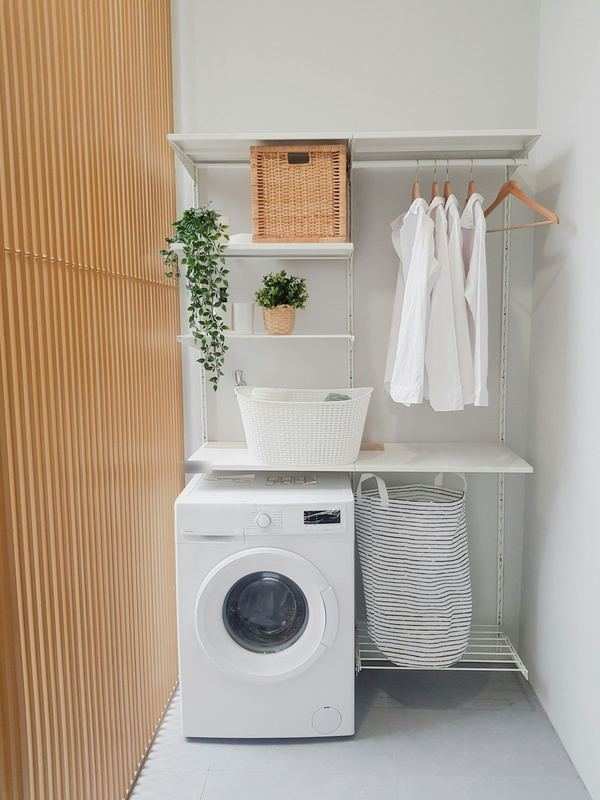
If your washer sits in a closet or a corner, our small laundry room ideas cover what to keep by the machines and how to get clothes from dirty to put away.
03Pack it in a bin with a tight lid, not a cardboard box
Both pest guides point to the same container: one with a tight-fitting lid. [2] [3]
- Pick the bin to fit the space first (under the bed, the top closet shelf), then pack what fits. Measure the clearance under your bed before you buy.
- Put the clothes you'll want first, like the first light jacket of spring, on top.
- Our suggestion: tape a list of what's inside to the end of the bin that faces out. Next season you'll know which bin to open without pulling all of them out.

04Keep the bin in a heated room
When space is tight, it's tempting to put the off-season bin in the basement storage cage or a storage unit. University of Nebraska–Lincoln Extension advises against storing textiles in attics, basements, kitchens and unheated areas, where temperature and humidity swing too much, and suggests keeping them away from outside walls. [4]
- The University of Kentucky guide also notes that clothes moth larvae prefer dark, undisturbed spots, including closets, chests, boxes, basements and attics. [2] A sealed bin you open twice a year is safer than an open shelf nobody touches.
- In a small apartment, under the bed or the top closet shelf in a room you heat is usually the best spot you have.
05Don't count on cedar
Cedar blocks and hangers are sold as moth protection. The University of Kentucky guide says cedar closets or chests are seldom effective in deterring clothes moths, because they usually can't hold in enough cedar oil. [2] The Oregon State handbook says a cedar chest may help only if it's tightly fitted. [3]
- Cleaning first and using a tight lid do more than a cedar ball tossed into an open box.
- Mothballs are a different product. The Oregon State handbook says they work only in tightly sealed containers and that long-term exposure may harm people. The Kentucky guide says to follow the label and keep them away from children and pets. [2] [3]
06Quick fixes for common problems
| The problem | Likely cause | Try this |
|---|---|---|
| Closet won't close in the fall | Two seasons on one rod | Swap seasons in one sitting |
| Small holes in a wool sweater | Worn, then stored unwashed | Wash or dry-clean before storing |
| Clothes smell musty in spring | Packed damp, or stored in the basement | Dry fully; keep the bin in a heated room |
| Can't find the bin with your coat | No label | Tape a contents list to the end of each bin |
07If you only do one thing today
Before anything from this summer goes into a bin, set aside every piece you've worn since its last wash and put it in the laundry first. Clean and dry goes in the bin; everything else waits.
Also free: the closet rod calculator, to see whether the clothes that stay fit on the rod.
Keep reading
 Closet
Small Closet Organization: A Full Closet and Nothing to Wear?
Small closet organization that starts with what you actually wear.
 Bedroom
Small Bedroom Storage Ideas That Don't Fill the Room Back Up
Take things out first, use the space under the bed, and anchor tall furniture.
 Laundry
Small Laundry Room Ideas: Storage That Keeps the Dryer Area Clear
Keep only laundry things by the machines, clear the dryer area, and store packets up high.


Sources
- Nippon.com, "Deliverance from Death," from the series A Journey Through Japanese Haiku (May 20, 2024)
- University of Kentucky Entomology, "Clothes Moths" (ENTFACT-609)
- Pacific Northwest Insect Management Handbook (Oregon State University), "Nuisance and household pests: Clothes moth"
- University of Nebraska–Lincoln Extension, "Care of Quilts: Storage and Display" (G1820)
Free tools: the printable seasonal clothes swap checklist, and the Will It Fit? storage bin size calculator to check that a bin fits before you buy it.
Photos: Priscilla Du Preez and Shoham Avisrur on Unsplash